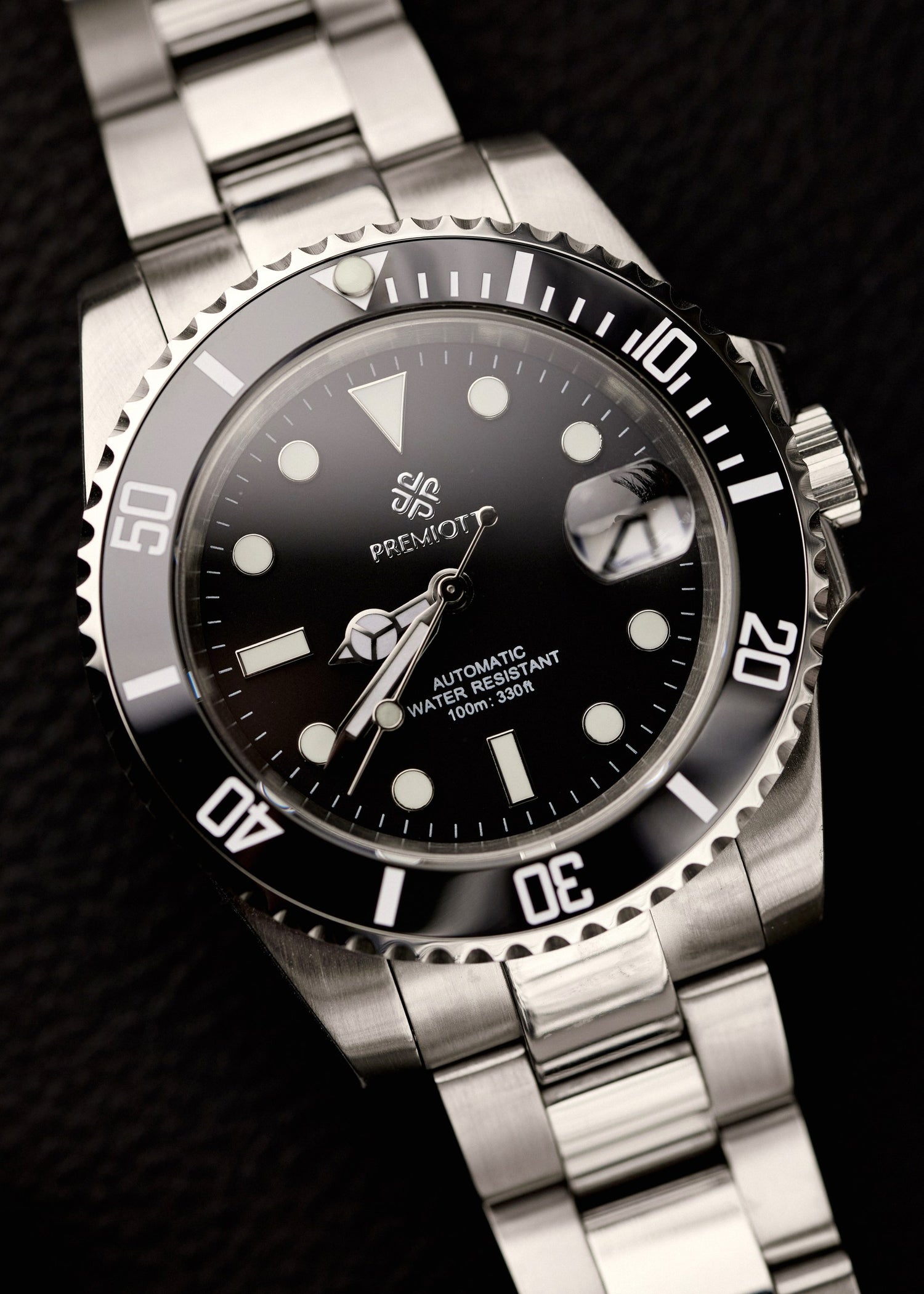

Automatic Watch Maintenance
An automatic watch doesn't need a complicated ritual, but a few simple habits make the difference between a movement that runs steadily for years and one that ends up at the watchmaker often for avoidable problems. Real maintenance comes down to a handful of things: how you wear it, how you set it, what to avoid, and how you clean it. We go through them one by one below.
Daily wear is, in fact, its basic maintenance
An automatic watch has no battery, it's wound by the motion of your wrist, through a metal rotor that swings freely with every movement and gradually winds the mainspring. In practice, the best thing you can do for an automatic is wear it as often as possible: it stays consistently wound and rarely ends up stopping on the nightstand. We cover the mechanism in depth in our Seiko NH35 movement guide, used across every Premiott model.
If you wear the watch with breaks, that's no problem, it just means that any break longer than the movement's power reserve (roughly 41 hours for the NH35 class) will leave you finding it stopped. That's not a malfunction; it's the normal behavior of any automatic movement.
What to do when it stops: restarting and manual winding
If you find the watch stopped, all you need to do is restart it: pull the crown out to the setting position, set the current time, and put it back on, worn, it winds itself again within a few hours. If you want it running right away, you can wind it manually from the crown:
- Turn the crown gently 20-30 turns, without forcing it at the end of its travel, the movement has a slipping clutch that prevents overwinding, but there's no reason to test its limits.
- Push the crown all the way back in once you're done, whether you've set the time, the date, or wound it manually. A crown left out, even slightly, cancels the case's protection against water and dust.
How to set the date safely, without forcing the movement
All automatic movements with a date function, including the NH35, have a "danger zone" around midnight, when the date-change gear train is already in motion, preparing to advance automatically. If you pull the crown and try to manually set the date during this window, you can force the gear train and, over time, damage the date-change mechanism.
The simple rule: avoid manually setting the date between roughly 9 PM and 2 AM. Outside that window, you can set the date any time, without risk, pull the crown to the first position, turn it to the desired day, then push it back in. If you're not sure what the watch's "real" time is (for example, after finding it stopped), the safest approach is to set the time first, to a clear point in the afternoon, and then the date.
Magnetism: the most often overlooked symptom
A mechanical movement, with its fine metal components, can be affected by strong magnetic fields, speakers, magnetic phone cases, laptop lids, straps with magnetic clasps. If the watch suddenly starts gaining or losing far more than normal (minutes a day, not tens of seconds), that's the typical sign that the balance spring has become magnetized.
The fix is simple and usually inexpensive: a demagnetization at a watchmaker, a process that takes a few minutes and doesn't involve opening the movement or replacing any parts. Full servicing isn't necessary, if accuracy suddenly returns to normal after a large deviation, magnetism is the most likely cause, not a mechanical fault.
Water: what a watch with 3 ATM resistance really tolerates
3 ATM water resistance, found on models like The Heritage is designed for occasional contact with water, not for immersion. In practice, that means:
- Fine: handwashing, rain, accidental splashes from a tap or while doing dishes.
- Not recommended: swimming, showering, saunas, or any full immersion, the pressure and variable temperature involved go beyond what an entry-level movement is designed to tolerate consistently.
One habit matters more than all the others: the crown must always be pushed all the way in before any contact with water. A crown left out, even by a millimeter, cancels the case's water resistance, regardless of its rated figure. Gaskets wear out over time, which is why our warranty page recommends a periodic check to maintain water resistance, not just at first use.
Temperature and shocks: common sense, not paranoia
A mechanical movement tolerates normal daily wear well, but it isn't designed for hard impacts (direct blows, drops onto hard surfaces) or extreme temperatures (saunas, a car heated by the sun, prolonged frost). If you're about to do something with impact risk, contact sports, heavy DIY work, the simplest approach is to take the watch off for that stretch of time.
Cleaning the case and bracelet
For everyday cleaning, a soft, slightly damp cloth is enough for dust, sweat, or fingerprints on the sapphire crystal and case. For a more thorough cleaning of a steel bracelet: first check that the crown is fully pushed in then use lukewarm water with a little mild soap and a soft brush for the areas between the links, where dust and skin residue tend to build up. Rinse with a damp cloth and dry it thoroughly including between the links, before putting it back on.
The sapphire crystal on the dial and the transparent caseback, used across every Premiott model, holds up well against everyday scratches, but it's still worth cleaning with a soft cloth, not abrasive materials. We go into its properties in the what sapphire crystal means guide.
Caring for a leather strap
A leather strap needs a little more attention than a metal bracelet, because it absorbs sweat and moisture. A few simple habits go a long way toward extending its life: avoid prolonged contact with water or heavy sweating (if it gets wet, let it dry naturally, away from direct heat); rotate straps if you own more than one, instead of wearing the same one daily; and wipe it occasionally with a dry, soft cloth to remove dust and sweat residue from the inside.
Storing it when you're not wearing it
Worth being honest here: for a movement in the NH35 class, with a power reserve of roughly 41 hours, an automatic winder isn't necessary. It's a useful accessory for large collections with complicated movements that lose complex settings (perpetual calendar, moon phase) every time they stop, that's not the case with Premiott models. The simplest approach is to let it sit stopped, in a box or drawer away from dust and moisture, and restart and set it in a few seconds when you want to wear it again.
Periodic servicing: how often, and what it honestly costs
Like any movement with moving parts, an automatic benefits, every few years, from a checkup at a watchmaker, typically every 5-7 years or sooner if you notice a much larger accuracy deviation than normal, or signs of moisture under the crystal. There's no universal mandatory interval; it depends on how consistently the watch is worn.
The good news, covered in depth in our Seiko NH35 movement guide, is that this movement is among the most widely used in the world, so parts and servicing expertise are easy to find at almost any watchmaker, and the cost of a checkup, or of an eventual replacement, is usually affordable, unlike rare or proprietary movements.
What the 24-month warranty covers
Every Premiott watch comes with a 24-month warranty which covers manufacturing defects and movement accuracy issues under normal conditions of use. It doesn't cover normal wear, scratches from everyday use, wear on leather straps, damage from impact, water damage caused by a crown left unpushed, or date-setting during the risk window described above. Full details are on the warranty page, worth reading once, especially the section on the crown and water.
Conclusion
Maintaining an automatic watch doesn't call for special equipment, just a handful of consistent habits: wear it often, set the date outside the risk window, keep it away from strong magnets, respect its water-resistance limits, clean it gently, and schedule a checkup every few years. The movement takes care of the rest, worn day after day. You can see every model in the configurator or, if you want the basics first, in our how to choose your first automatic watch guide.
Frequently asked questions about automatic watch maintenance
Do I need to manually wind the crown every day, like an old mechanical watch?
No, not if you wear the watch daily, the normal motion of your wrist winds it automatically, through the internal rotor. Manual winding from the crown is only useful when the watch has been stopped for a while and you want to start it running right away, without waiting a few hours of wear.
What do I do if the watch suddenly drifts much more than before?
It's most likely magnetism, from speakers, magnetic phone cases, or similar sources. The typical symptom is a sudden, large deviation (minutes a day, not seconds), not a gradual decline. The fix is a quick demagnetization at a watchmaker, a simple process that doesn't involve opening the movement.
Can I wear the watch in the shower or while swimming if it has 3 ATM resistance?
It's not recommended. 3 ATM resistance handles rain, handwashing, or accidental splashes well, but it isn't designed for full immersion, such as showering, saunas, or swimming. Regardless of the situation, the crown must always be pushed all the way in before any contact with water.