
The Seiko NH35 Movement, Explained Simply
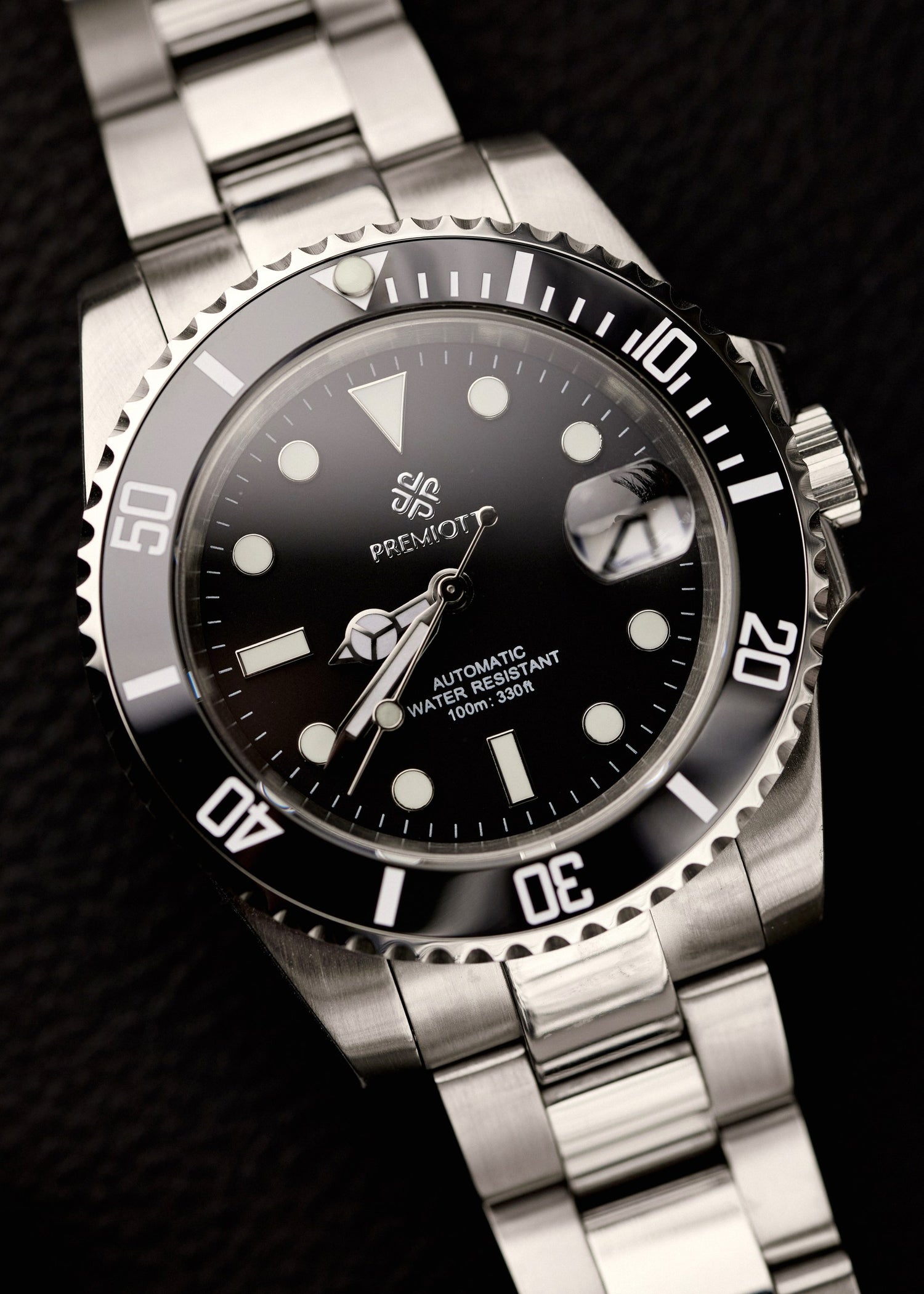
If you've ever read the description of an affordable automatic watch, from independent Japanese, American, or European brands, you've probably run into the same three letters and two digits: Seiko NH35. It's the movement inside all four Premiott models, and at the same time one of the most widely used automatic movements in the world. In this guide we explain, without myths or inflated numbers, what the NH35 is, why it became the standard for independent watchmaking, and what its specifications actually mean for someone who's going to wear the watch every day.
Who makes the NH35, and why it became the industry standard
The NH35 is made by Seiko Instruments Inc. (TMI/SII) the components and movements division of the Seiko group, separate from the Seiko watch brand itself. TMI produces movements at industrial scale, both for the retail market and for hundreds of independent brands worldwide, who fit them into their own cases and dials.
The reason the NH35 has become almost synonymous with "affordable, reliable automatic watch" isn't that it's the most sophisticated movement on the market, it's the balance it strikes: reasonable production cost, consistent manufacturing tolerances, standardized parts available globally, and, perhaps most important, decades of large-scale real-world use that have proven its reliability outside a lab. An independent brand that chooses the NH35 isn't making a hidden compromise, it's knowingly choosing the movement with the best ratio of robustness, cost, and service availability.
What the numbers on the spec sheet actually mean
NH35 specifications show up often, but are rarely explained. Here's what each one actually means:
21,600 vph, the oscillation frequency
"vph" stands for vibrations per hour, and it describes how many times per hour the movement's balance wheel oscillates, essentially its "pulse." At 21,600 vph, the balance wheel oscillates 6 times per second, which gives the second hand the specific, slightly trembling motion of a mechanical watch, quite different from the sharp "tick" of a quartz one. It's a moderate frequency, not among the fastest (28,800 vph, found in pricier movements), nor among the slowest, a reasonable compromise between precision and component wear.
A power reserve of roughly 41 hours
This is how long the watch keeps running after being taken off the wrist, on the energy stored in the mainspring. In practice, if you take the watch off on Friday evening, it'll still be running on Saturday at noon. It's not an impressive figure next to premium movements with extended reserves (70+ hours), but it's enough for an ordinary weekend without having to restart and reset the watch every time.
Hacking and hand-winding
Two practical features, not just spec-sheet numbers. Hacking means the second hand stops completely when you pull the crown out to the setting position, useful for setting the exact time, down to the second. Hand-winding means you can wind the mainspring manually by turning the crown, instead of waiting for the rotor to do it on its own through wrist motion, useful especially if the watch has sat unworn for a few days and you want to start it right away, without waiting.
How accurate is the NH35, honestly
This is where honesty matters more than marketing: the NH35 is not a chronometer-grade movement. The manufacturer's official spec sheet lists a daily deviation somewhere between -20 and +40 seconds depending on the watch's position, temperature, and how consistently it's worn. In practice, many individual units run better than that, it's not unusual for a well-regulated NH35 to stay within a few seconds a day, but that remains an empirical observation, not a performance guarantee, and it varies from unit to unit.
For comparison, an ordinary quartz watch drifts by a few seconds a month, not a day. Someone who buys an automatic watch isn't doing it for chronometer-level precision, but for the visible mechanics behind the motion, a subject we cover in detail in the automatic vs. quartz guide.
The unidirectional winding rotor
Unlike automatic movements with bidirectional winding (which wind the spring regardless of which way the rotor spins), the NH35 uses a unidirectional winding system, the metal rotor winds the mainspring only when it spins in one direction, through a ratchet mechanism. In practice this means somewhat lower winding efficiency from motion (half the rotations contribute directly, the other half is mechanically "wasted"), offset by a simpler construction with fewer parts that can wear out or fail. It's another example of the NH35's philosophy: not the most technically advanced solution possible, but the most robust and easiest to maintain long-term.
A reputation for durability
The NH35 isn't a fragile movement built for a display case. It's derived from a family of Seiko movements used for decades in field watches and everyday, heavy-use timepieces, and its reputation in the global community of watchmakers and enthusiasts is one of endurance, it tolerates the moderate shocks of daily wear and constant use without needing frequent adjustment. That doesn't mean it's indestructible, no mechanical movement is, but it explains why so many independent brands, across very different price categories, choose it as the base for watches meant to last years, not seasons.
Why it can be repaired almost anywhere
Perhaps the most underrated advantage of the NH35 has nothing to do with performance, and everything to do with availability. Being one of the most widely used automatic movements in the world, its spare parts, springs, rotors, crowns, gaskets, are mass-produced and easy to source, and the service procedure is well documented and familiar to nearly any competent watchmaker, not just the workshop that originally assembled the watch. In practice, you're not dependent on a single supplier or a single specialist: if you ever need an inspection, a lubrication, or a part replacement, you can find someone capable of doing it, at a reasonable cost, almost anywhere. That's a real long-term advantage, and far more relevant for an object worn for years than a few extra or missing seconds a day.
NH35 vs. pricier movements: what you gain and what you don't
More expensive automatic movements, with additional modules, advanced decorative finishing, extended power reserve, or higher frequencies, generally win on accuracy, power reserve, and the visible aesthetics through a transparent caseback (Geneva stripes, hand-beveled edges, engravings). These are real differences, not empty marketing, and they make sense for someone whose main goal is performance or fine watchmaking.
What you don't automatically gain just by paying more is reliability or ease of service, a rare movement can, paradoxically, be harder to repair precisely because fewer watchmakers encounter it often. For many buyers, the NH35 remains the rational choice: not the highest-performing movement possible, but a proven one, easy to maintain, with a value-for-money ratio that's hard to match at this level.
How Premiott works with the Seiko NH35
At Premiott, all four models, The Mariner The Just Date The Heritage and The LadyJust use the Seiko NH35 movement, with no variation between them. Every watch has sapphire crystal on both the dial and the caseback, and the transparent back leaves the movement visible, the rotor swinging with every motion of the wrist, the gear train, the spring winding. You can read more about this in the sapphire crystal guide.
The watches are hand-assembled in our workshop in Cluj-Napoca, and every unit leaves us with a 24-month warranty. If you want an extra layer of personalization, every model can be engraved on the caseback, up to 10 characters, with diacritics supported. You can read more about the philosophy behind the assembly on the Cluj-Napoca workshop page, or, if this is your first automatic watch, in the guide on how to choose your first automatic watch.
If you want to compare the available models and configurations, you can start directly from the configurator.
Frequently asked questions about the Seiko NH35 movement
Is the NH35 a "cheap" movement in a bad way?
Not in the sense of poor quality. The NH35 is mass-produced, which lowers its cost compared to artisanal or niche movements, but that doesn't make it inferior in reliability, quite the opposite: large-scale production tends to come with consistent manufacturing tolerances and an extensive track record of real-world use that confirms its robustness.
How often does a watch with an NH35 need servicing?
Like any movement with moving parts, it benefits, every few years, from an inspection and possibly a lubrication by a watchmaker. There's no universal interval, it depends on how consistently the watch is worn and the conditions it's exposed to, but unlike rarer movements, service for the NH35 is easy to find and generally affordable.
Does the NH35 movement differ between Premiott models?
No. All four models, The Mariner, The Just Date, The Heritage, and The LadyJust, use the same Seiko NH35 movement, visible through the transparent sapphire caseback, regardless of the configuration chosen for dial, case, or strap.